This Silkland 54Gbps 16K DisplayPort Cable 2.1 review looks at a long, feature-rich connection for PC gamers and multi-monitor users.
Its 10-foot length, high-resolution support, and reinforced construction make it worth considering when both ends of a setup have compatible DisplayPort ports.
Silkland DP Cable Review Summary
The quick verdict
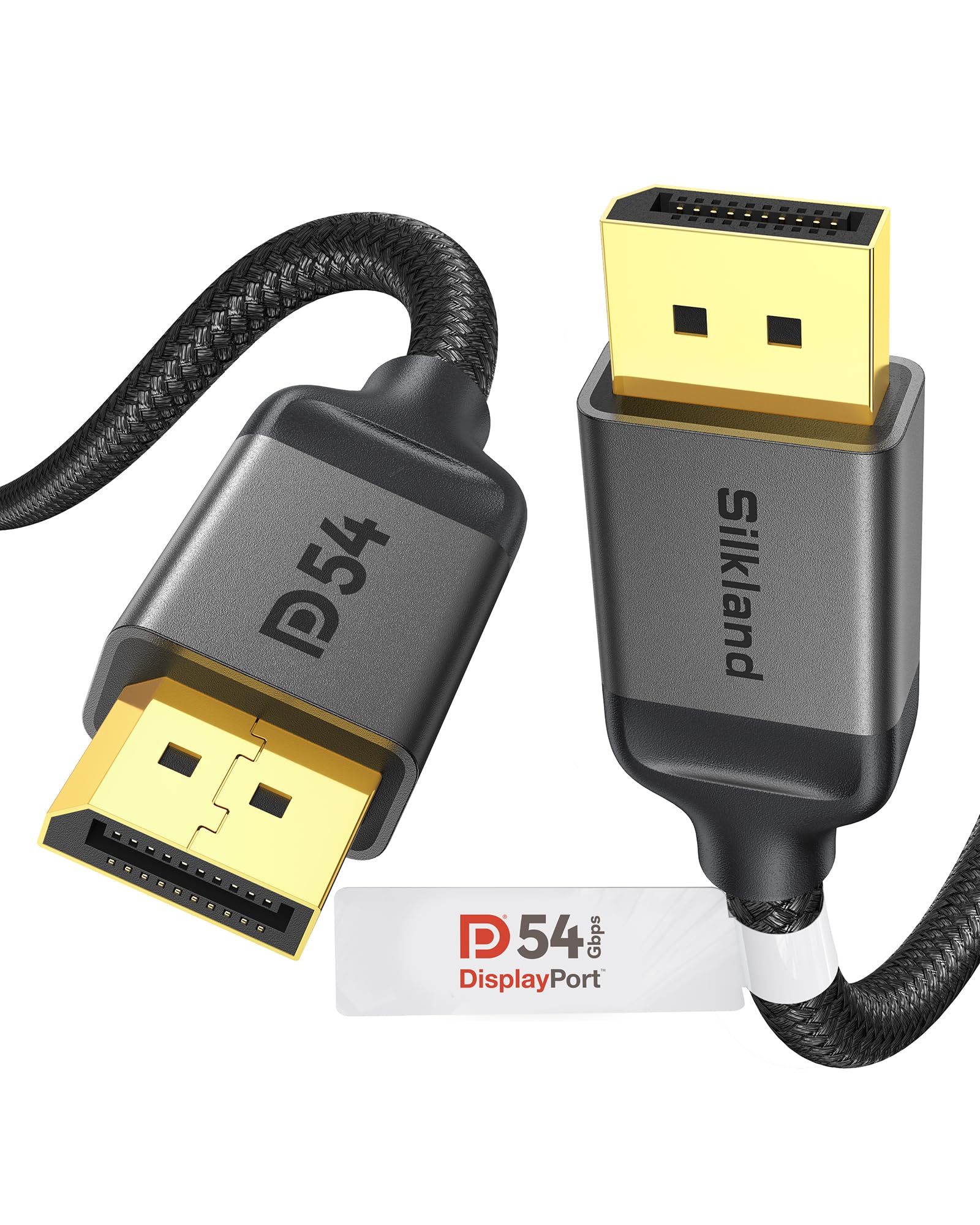
7,000+ ratings
Read Amazon ReviewsSilkland 16K DisplayPort Cable
A 10-foot DisplayPort cable for PC and monitor setups seeking high refresh rates, broad compatibility, and a durable braided design.
- 10-foot male-to-male DisplayPort cable for connecting a DisplayPort-enabled desktop or laptop to a monitor.
- Supports up to 16K (15360 × 8640) at 60Hz with DSC, 8K at 120Hz, 4K up to 240Hz, and 2K up to 360Hz.
- Lists 54Gbps bandwidth, HBR3, DSC 1.2a, Dynamic HDR, HDCP 2.2, and 3D stereo imaging.
- Backward compatible with DisplayPort 2.0, 1.4, 1.3, 1.2, 1.2a, 1.1, and 1.0; supports DP and DP++.

Pros
- Broad high-resolution and high-refresh support gives it room to serve demanding display setups.
- The 10-foot length can simplify routing when a PC and monitor are not close together.
Consider before buying
- The full resolution and refresh combinations depend on the capabilities of both the source device and the display, and some listed modes use DSC.
- A 10-foot cable may leave extra slack in compact setups; measure the route and space for cable management before choosing.
Read the full review summary
The Silkland cable combines a 10-foot male-to-male DisplayPort connection with support for resolutions up to 16K at 60Hz with DSC, plus several high-refresh-rate combinations for 8K, 4K, and 2K displays.
It also lists Dynamic HDR, DSC 1.2a, HDCP 2.2, multistream transmission, and uncompressed audio pass-through, making it a versatile fit for demanding desktop displays.
Its tinned copper conductors, triple shielding, nylon braid, and latch-free connector design address practical concerns in a cable that may be routed through a desk or behind a monitor.
The key buying check is whether your graphics card and display support the resolution, refresh rate, and DisplayPort features you want; the cable alone cannot establish what a full system will deliver.
The buying factors
Silkland DP Cable Scorecard
Editorial scores reflect listed features and buyer fit; they are not laboratory measurements or customer ratings.
Resolution and refresh range
The supplied specifications cover up to 16K at 60Hz with DSC, along with high-refresh 8K, 4K, and 2K modes.
Connection reach
At 10 feet, it offers more routing flexibility than a short desk cable, though buyers should measure their path.
Build and handling
Triple shielding, tinned copper, braided nylon, and a groove on the latch-free plug are useful design choices.
Display and audio features
Dynamic HDR, DSC, HDCP, 3D imaging, multistream transmission, and multichannel audio are included in the feature set.
Compatibility breadth
It is designed for DisplayPort-equipped computers and monitors and lists backward compatibility across several DP generations.
Setup flexibility
The no-buckle connector may be easier to remove in tight spaces, while the 10-foot run suits layouts needing extra reach.
Key Features and Specifications of Silkland DP Cable
- 10-foot male-to-male DisplayPort cable for connecting a DisplayPort-enabled desktop or laptop to a monitor.
- Supports up to 16K (15360 × 8640) at 60Hz with DSC, 8K at 120Hz, 4K up to 240Hz, and 2K up to 360Hz.
- Lists 54Gbps bandwidth, HBR3, DSC 1.2a, Dynamic HDR, HDCP 2.2, and 3D stereo imaging.
- Backward compatible with DisplayPort 2.0, 1.4, 1.3, 1.2, 1.2a, 1.1, and 1.0; supports DP and DP++.
- Supports multistream transmission and uncompressed 7.1, 5.1, and 2.0 audio pass-through.
- Uses 28AWG tinned copper conductors, triple shielding, a double nylon braid, and 24K gold-plated connectors.
- The plugs have no latch and include a groove intended to make removal easier in confined spaces.
Pros and Cons of Silkland DP Cable
Pros
- Broad high-resolution and high-refresh support gives it room to serve demanding display setups.
- The 10-foot length can simplify routing when a PC and monitor are not close together.
- Braided exterior, triple shielding, and tinned copper conductors provide a sturdier construction profile than a basic smooth cable.
- Latch-free plugs with a pull groove may be convenient when access behind a display is limited.
Consider before buying
- The full resolution and refresh combinations depend on the capabilities of both the source device and the display, and some listed modes use DSC.
- A 10-foot cable may leave extra slack in compact setups; measure the route and space for cable management before choosing.
- The 54Gbps rating is lower than the 80Gbps DP80 specification offered by the alternative listed below, which may matter for buyers pursuing higher-bandwidth modes.
Who Should Buy Silkland DP Cable?
Good fit
Consider the Silkland DP Cable if you need a DisplayPort run with more reach than a short desk cable and want a broad set of supported display modes.
Its 10-foot length can help with a PC placed under or beside a desk, while the braided jacket and shielding suit a cable that will be routed around furniture or monitor mounts.
It is also a reasonable match for a gaming or multi-display setup where the source and screen already support the desired DisplayPort features.
Check the exact output modes of both devices, including whether DSC is needed for your preferred resolution and refresh rate, and confirm the route length before ordering.
Who should skip it
Skip this model if your equipment connects through HDMI or another connector and does not provide DisplayPort ports. Also consider a shorter cable if your devices sit close together and you want to minimize excess length.
If you specifically need the higher bandwidth and extreme refresh-rate modes associated with an 80Gbps DP80 cable, compare that requirement against your graphics card and monitor before choosing this 54Gbps model.
What the Silkland DP Cable means for your setup
Resolution claims and system matching
The listed modes span up to 16K at 60Hz with DSC, 8K at 120Hz, 4K at up to 240Hz, and 2K at up to 360Hz.
These are maximum combinations to check against your display and graphics hardware; the cable does not upgrade a device that cannot output or accept the selected mode.
The value of a 10-foot run
Ten feet provides flexibility for routing from a tower under a desk or around a monitor arm. That reach can make placement easier, but it also means more cable to manage in a compact workspace.
Measuring the path, including bends and connector clearance, helps determine whether this length fits neatly.
Construction and connector access
Tinned copper conductors and triple shielding are intended to help with signal integrity and interference resistance, while the nylon braid protects the exterior during ordinary routing.
The plugs omit a latch and add a groove for pulling them free, a practical detail if the ports are difficult to reach. These construction features describe the design rather than guaranteeing a particular lifespan.
Audio, HDR, and multiple screens
Dynamic HDR, HDCP 2.2, 3D imaging, and uncompressed multichannel audio broaden the cable's stated feature set beyond basic video.
Multistream transmission may be useful when planning a multi-monitor arrangement, but check your computer's output support and display configuration before relying on a particular layout.
Alternatives to Silkland DP Cable
One useful alternative is included because it offers a materially higher bandwidth tier, though its short length suits a different setup.
Computer DisplayPort Cables alternative
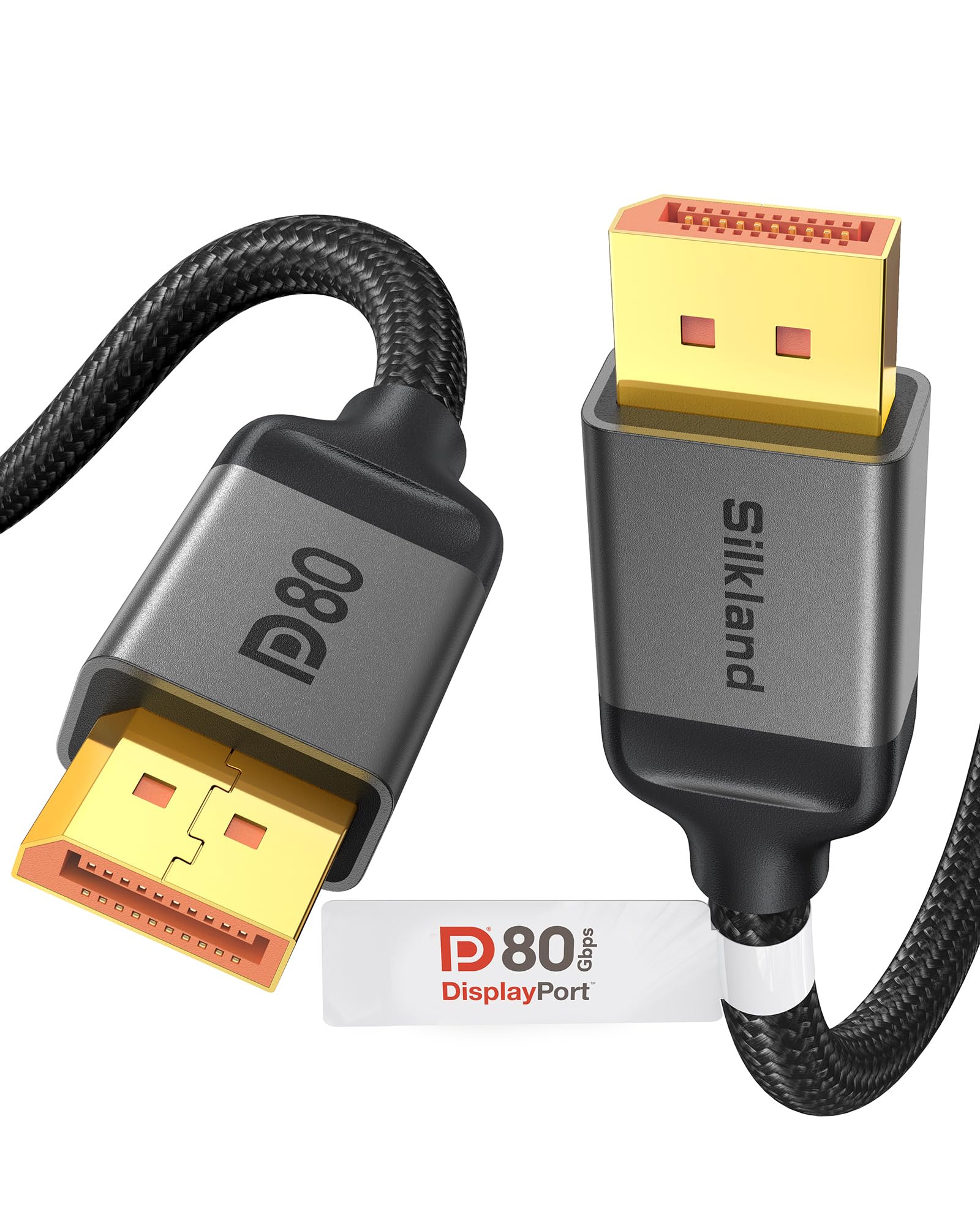
2,000+ ratings
Read Amazon ReviewsSilkland 80Gbps DP80 DisplayPort Cable, 1.6 ft
Choose the 80Gbps model if your compatible graphics card and monitor can use its higher-bandwidth modes and a short cable reaches your devices.
The 10-foot, 54Gbps model is the more practical fit when reach matters more than the additional bandwidth.
- This 1.6-foot DP80 cable lists 80Gbps bandwidth and supports uncompressed 4K at 240Hz, 8K at 60Hz, and 2K at 540Hz; with DSC, it lists up to 16K at 60Hz, 8K at 240Hz, and 4K at 540Hz.
- The Silkland 16K DisplayPort Cable provides 54Gbps bandwidth and a 10-foot run, with listed high-resolution modes including up to 16K at 60Hz with DSC.
Is Silkland DP Cable Worth It?
The Silkland 16K DisplayPort Cable is worth considering for a DisplayPort desktop setup that needs a 10-foot run, broad display-mode support, and a braided, shielded build.
Its feature range is substantial for gaming and multi-monitor use, provided the computer and monitor support the modes you plan to use.
Before buying, match the cable's listed modes to both devices and decide whether 54Gbps and 10 feet suit your setup.
Buyers prioritizing higher bandwidth and able to use a short run should compare the DP80 alternative; for a longer route with a capable but not DP80-dependent system, this cable is the more suitable fit.
Your review at a glance
7,000+ ratings
Read Amazon ReviewsSilkland 16K DisplayPort Cable
A 10-foot DisplayPort cable for PC and monitor setups seeking high refresh rates, broad compatibility, and a durable braided design.
- 10-foot male-to-male DisplayPort cable for connecting a DisplayPort-enabled desktop or laptop to a monitor.
- Supports up to 16K (15360 × 8640) at 60Hz with DSC, 8K at 120Hz, 4K up to 240Hz, and 2K up to 360Hz.
- Lists 54Gbps bandwidth, HBR3, DSC 1.2a, Dynamic HDR, HDCP 2.2, and 3D stereo imaging.
- Backward compatible with DisplayPort 2.0, 1.4, 1.3, 1.2, 1.2a, 1.1, and 1.0; supports DP and DP++.